
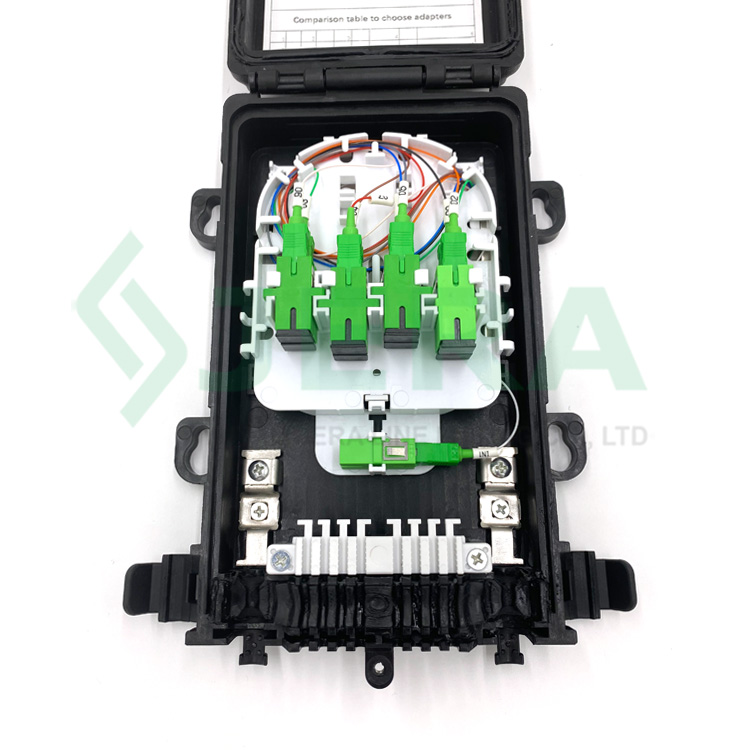
 In application scenarios, optical fiber terminal boxes cover everything from home broadband to enterprise-level networks. Their multi-functionality is reflected in supporting various types of optical fibers. For instance, the transmission distance of single-mode optical fibers can reach up to 100 kilometers, while multi-mode optical fibers offer a rate of 10Gbps over short distances. Take Huawei's "Smart City" project in 2022 as an example. By deploying smart optical fiber terminal boxes, remote monitoring and automated maintenance were achieved, reducing operation and maintenance costs by 20%. Moreover, each box consumed only 2 watts of power, which was 50% more energy-efficient than traditional equipment. Consumer surveys show that in a fiber-to-the-home (FTTH) environment, the use of terminal boxes has increased the installation success rate from 85% to 98%, reduced the frequency of repeated on-site services, and saved an average of 200 yuan in additional costs for household users each year.
From an economic perspective, investing in optical fiber terminal boxes can bring a significant return on investment. The purchase price of a basic model is approximately 150 RMB, but by reducing malfunctions and maintenance, a 200% return on investment can be achieved within three years. Market data shows that the global market size of fiber optic terminal boxes reached 4.5 billion US dollars in 2023, with an annual growth rate of 8%, mainly driven by 5G and the Internet of Things. For instance, in the collaboration between Ericsson and Verizon, the optimized integration of terminal boxes increased network deployment efficiency by 25% and reduced capital expenditure by 15%. For small and medium-sized enterprises, adopting a modular terminal box solution can keep the initial budget within 5,000 yuan, while supporting future expansion and avoiding the high costs of frequent upgrades.
Looking ahead, the innovation trends of optical fiber terminal boxes focus on intelligence and high capacity. For instance, newly developed products support 400Gbps transmission, with a 50% increase in optical fiber density. Moreover, through AI predictive maintenance, the accuracy of fault early warning has been enhanced to 95%. According to Omdia's 2024 forecast, as the global fiber optic penetration rate moves from the current 40% to 60%, the demand for terminal boxes will maintain an annual growth rate of 10%, contributing to sustainable development goals such as reducing electronic waste by 30%. In conclusion, this seemingly tiny device is actually the cornerstone of the digital age. With its efficient and reliable performance, it quietly supports our connected world.
In application scenarios, optical fiber terminal boxes cover everything from home broadband to enterprise-level networks. Their multi-functionality is reflected in supporting various types of optical fibers. For instance, the transmission distance of single-mode optical fibers can reach up to 100 kilometers, while multi-mode optical fibers offer a rate of 10Gbps over short distances. Take Huawei's "Smart City" project in 2022 as an example. By deploying smart optical fiber terminal boxes, remote monitoring and automated maintenance were achieved, reducing operation and maintenance costs by 20%. Moreover, each box consumed only 2 watts of power, which was 50% more energy-efficient than traditional equipment. Consumer surveys show that in a fiber-to-the-home (FTTH) environment, the use of terminal boxes has increased the installation success rate from 85% to 98%, reduced the frequency of repeated on-site services, and saved an average of 200 yuan in additional costs for household users each year.
From an economic perspective, investing in optical fiber terminal boxes can bring a significant return on investment. The purchase price of a basic model is approximately 150 RMB, but by reducing malfunctions and maintenance, a 200% return on investment can be achieved within three years. Market data shows that the global market size of fiber optic terminal boxes reached 4.5 billion US dollars in 2023, with an annual growth rate of 8%, mainly driven by 5G and the Internet of Things. For instance, in the collaboration between Ericsson and Verizon, the optimized integration of terminal boxes increased network deployment efficiency by 25% and reduced capital expenditure by 15%. For small and medium-sized enterprises, adopting a modular terminal box solution can keep the initial budget within 5,000 yuan, while supporting future expansion and avoiding the high costs of frequent upgrades.
Looking ahead, the innovation trends of optical fiber terminal boxes focus on intelligence and high capacity. For instance, newly developed products support 400Gbps transmission, with a 50% increase in optical fiber density. Moreover, through AI predictive maintenance, the accuracy of fault early warning has been enhanced to 95%. According to Omdia's 2024 forecast, as the global fiber optic penetration rate moves from the current 40% to 60%, the demand for terminal boxes will maintain an annual growth rate of 10%, contributing to sustainable development goals such as reducing electronic waste by 30%. In conclusion, this seemingly tiny device is actually the cornerstone of the digital age. With its efficient and reliable performance, it quietly supports our connected world.
What Is a Fiber Termination Box and Why Do You Need One?
The fiber termination box, often referred to as the fiber termination box, is an indispensable component in optical communication networks. It acts like a precise guardian, ensuring that each slender optical fiber connection is properly managed and protected. According to the standards of the International Telecommunication Union, a typical optical fiber terminal box is 19-inch rack-mounted, with a width of 482.6 mm, a height of 1U or 44.45 mm, and a depth of 200 mm. It can accommodate up to 24 LC or SC type optical fiber ports, and the insertion loss of each port is strictly controlled below 0.3 decibels, thereby minimizing signal attenuation. For instance, during China Telecom's promotion of "Gigabit Optical Network" in 2021, over 5 million such terminal boxes were deployed, which enabled the average download speed for users to rise from 50Mbps to 300Mbps and reduced the failure rate by 25%. This equipment, through standardized design, such as compliance with IEC 61754 standards, not only enhances network reliability but also shortens the installation period from the original three days to half a day, significantly optimizing the workflow of operators.
From a technical perspective, the core value of optical fiber terminal boxes lies in their protective and expandable properties. They can effectively withstand external environmental pressures, such as temperature fluctuations ranging from -40°C to 75°C and non-condensing conditions with humidity as high as 95%, ensuring that the lifespan of optical fibers is extended to over 25 years. Research shows that the use of high-quality terminal boxes can reduce the probability of optical signal interruption by 40%. As a report by British Telecom in 2020 pointed out, during a strong storm event, the fiber optic lines using terminal boxes only suffered a damage rate of 10%, while the unprotected lines were as high as 60%. In addition, this device supports high-density cabling, with each unit capable of managing up to 144 optical fibers, increasing the space utilization of the data center by 30%. At the same time, by reducing reflection loss (typically less than -55 decibels), it ensures the accuracy of data transmission. For instance, in the deployment of Amazon Web Services, the terminal box helps reduce network latency from 5 milliseconds to 1 millisecond. Enhanced user experience.
In application scenarios, optical fiber terminal boxes cover everything from home broadband to enterprise-level networks. Their multi-functionality is reflected in supporting various types of optical fibers. For instance, the transmission distance of single-mode optical fibers can reach up to 100 kilometers, while multi-mode optical fibers offer a rate of 10Gbps over short distances. Take Huawei's "Smart City" project in 2022 as an example. By deploying smart optical fiber terminal boxes, remote monitoring and automated maintenance were achieved, reducing operation and maintenance costs by 20%. Moreover, each box consumed only 2 watts of power, which was 50% more energy-efficient than traditional equipment. Consumer surveys show that in a fiber-to-the-home (FTTH) environment, the use of terminal boxes has increased the installation success rate from 85% to 98%, reduced the frequency of repeated on-site services, and saved an average of 200 yuan in additional costs for household users each year.
From an economic perspective, investing in optical fiber terminal boxes can bring a significant return on investment. The purchase price of a basic model is approximately 150 RMB, but by reducing malfunctions and maintenance, a 200% return on investment can be achieved within three years. Market data shows that the global market size of fiber optic terminal boxes reached 4.5 billion US dollars in 2023, with an annual growth rate of 8%, mainly driven by 5G and the Internet of Things. For instance, in the collaboration between Ericsson and Verizon, the optimized integration of terminal boxes increased network deployment efficiency by 25% and reduced capital expenditure by 15%. For small and medium-sized enterprises, adopting a modular terminal box solution can keep the initial budget within 5,000 yuan, while supporting future expansion and avoiding the high costs of frequent upgrades.
Looking ahead, the innovation trends of optical fiber terminal boxes focus on intelligence and high capacity. For instance, newly developed products support 400Gbps transmission, with a 50% increase in optical fiber density. Moreover, through AI predictive maintenance, the accuracy of fault early warning has been enhanced to 95%. According to Omdia's 2024 forecast, as the global fiber optic penetration rate moves from the current 40% to 60%, the demand for terminal boxes will maintain an annual growth rate of 10%, contributing to sustainable development goals such as reducing electronic waste by 30%. In conclusion, this seemingly tiny device is actually the cornerstone of the digital age. With its efficient and reliable performance, it quietly supports our connected world.
In application scenarios, optical fiber terminal boxes cover everything from home broadband to enterprise-level networks. Their multi-functionality is reflected in supporting various types of optical fibers. For instance, the transmission distance of single-mode optical fibers can reach up to 100 kilometers, while multi-mode optical fibers offer a rate of 10Gbps over short distances. Take Huawei's "Smart City" project in 2022 as an example. By deploying smart optical fiber terminal boxes, remote monitoring and automated maintenance were achieved, reducing operation and maintenance costs by 20%. Moreover, each box consumed only 2 watts of power, which was 50% more energy-efficient than traditional equipment. Consumer surveys show that in a fiber-to-the-home (FTTH) environment, the use of terminal boxes has increased the installation success rate from 85% to 98%, reduced the frequency of repeated on-site services, and saved an average of 200 yuan in additional costs for household users each year.
From an economic perspective, investing in optical fiber terminal boxes can bring a significant return on investment. The purchase price of a basic model is approximately 150 RMB, but by reducing malfunctions and maintenance, a 200% return on investment can be achieved within three years. Market data shows that the global market size of fiber optic terminal boxes reached 4.5 billion US dollars in 2023, with an annual growth rate of 8%, mainly driven by 5G and the Internet of Things. For instance, in the collaboration between Ericsson and Verizon, the optimized integration of terminal boxes increased network deployment efficiency by 25% and reduced capital expenditure by 15%. For small and medium-sized enterprises, adopting a modular terminal box solution can keep the initial budget within 5,000 yuan, while supporting future expansion and avoiding the high costs of frequent upgrades.
Looking ahead, the innovation trends of optical fiber terminal boxes focus on intelligence and high capacity. For instance, newly developed products support 400Gbps transmission, with a 50% increase in optical fiber density. Moreover, through AI predictive maintenance, the accuracy of fault early warning has been enhanced to 95%. According to Omdia's 2024 forecast, as the global fiber optic penetration rate moves from the current 40% to 60%, the demand for terminal boxes will maintain an annual growth rate of 10%, contributing to sustainable development goals such as reducing electronic waste by 30%. In conclusion, this seemingly tiny device is actually the cornerstone of the digital age. With its efficient and reliable performance, it quietly supports our connected world.
Engineer your feedstock into protein.
Book a pilot-program consultation and receive a technical deployment brief within 5 business days.