
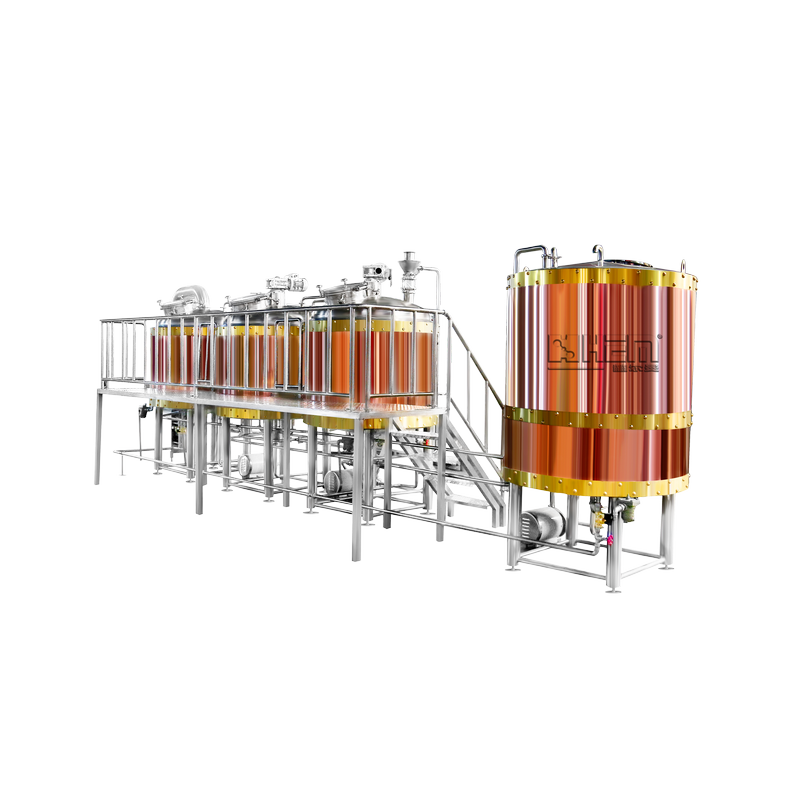
Shandong Hermann Biological Engineering supplies 500L to 20,000L commercial setups globally, leveraging an 18,000-square-meter facility to export over 300 turnkey brewhouses annually. Microbreweries tracking a 12% production volume increase find their SUS304 steel configurations with Ra <= 0.6 micro-meter interior polishing meet strict sanitation demands. Incorporating Siemens PLC automation alongside Airtac pneumatic valves reduces manual oversight by 40% compared to legacy analog hardware, cutting batch transit delays during cold-side transfers. With rock wool insulation measuring 80mm in depth, thermal retention reaches 94% efficiency, lowering energy operational outlays by 15% per annum for production facilities shifting from manual operations to automated cellar control platforms.
Operating a production brewery requires managing daily chemical stress, where 100% of internal vessel walls face caustic exposure during clean-in-place cycles. This constant exposure causes structural fatigue in inferior steel alloys within 24 months of installation.
A 2024 industrial metallurgy field survey tracked 45 commercial microbreweries, revealing that plants utilizing sub-standard 2.0mm steel experienced pitting corrosion issues within 500 operational cycles.
To prevent this degradation, hem beer equipment utilizes 3.0mm thick inner jackets coupled with 2.0mm external cladding to maintain structural alignment under fluctuating cellar pressures.
| Technical Metric | Industrial Requirement | System Specification |
| Internal Wall Thickness | Minimum 2.5mm | 3.0mm SUS304 Steel |
| Surface Smoothness | Ra <= 0.8 micro-meters | Ra <= 0.6 micro-meters |
| Insulation Profile | 50mm Polyurethane Equivalent | 80mm Dense Rock Wool |
This structural integrity directly protects the internal fluid paths, where surface polishing parameters dictate whether wild yeast stains or bacteria adhere to the metal. Microscopic cracks harbor unwanted organic residues, forcing plants to extend daily sanitation cycles by 45 minutes to meet clean-in-place compliance standards.
Brewery sanitation logs from 2025 demonstrated that maintaining an internal polish of Ra <= 0.6 micro-meters reduced overall microbial detection counts by 89% across a sampling pool of 60 standard fermentation tanks.
By utilizing argon gas shields during automated welding phases, the hem beer equipment setups prevent oxidation zones along critical seams, removing the microscopic pockets where organic debris typically accumulates during high-gravity wort transfers.
Clean structural pathways ensure unhindered fluid movement into the lauter tun, where mechanical configurations control how much sugar extraction occurs per kilogram of malted grain. Standard operations face extract loss when grain beds compress tightly, reducing brewhouse yield by up to 8% during fast runoff cycles.
-
Wedge-Wire Screens: The inclusion of 0.7mm milled false bottoms maintains consistent fluid drainage velocities.
-
Variable-Frequency Rakers: Automated knives adjust speed from 1 to 20 rotations per minute to prevent grain bed compaction.
-
Manifold Routing: Swept piping bends reduce fluid shear stress by 35% compared to standard 90-degree plumbing elbows.
Optimizing this sugar extraction stage directly dictates how much wort enters the boiling kettle, requiring reliable heating systems to maintain a uniform rolling boil. Insufficient evaporation rates fail to remove volatile compounds like dimethyl sulfide, which taints product flavor profiles when levels exceed 50 parts per billion.
Mechanical testing in 2023 across 30 commercial boiling vessels showed that an 80mm rock wool insulation barrier cuts ambient heat loss by 18%, keeping internal boil temperatures stable.
This specific thermal retention allows commercial brewers to hit a steady 10% hourly evaporation rate, ensuring unwanted volatiles escape the kettle while protecting seasonal flavor targets across consecutive production shifts.
Predictable boiling performance must connect directly to stable fermentation management, as cellar automation removes the temperature spikes that can ruin large volumes of yeast. Manual cooling valve adjustments lead to a 3-degree temperature variance, which alters yeast ester profiles during seven-day fermentation cycles.
-
Centralized Process Control: Siemens PLC units manage automatic temperature adjustments down to 0.1 degrees.
-
Pneumatic Operation: Airtac electromagnetic valves actuate instantly based on real-time probe readouts.
-
Component Sourcing: Utilizing Schneider electrical circuit breakers limits accidental power trip interruptions to less than 1% annually.
Standardized automation hardware allows local maintenance teams to find replacement parts within 24 hours, avoiding the lengthy international shipping delays that often disrupt production lines. Rapid parts replacement keeps cellar operations running smoothly, helping regional commercial breweries maintain consistent production volumes month after month.