
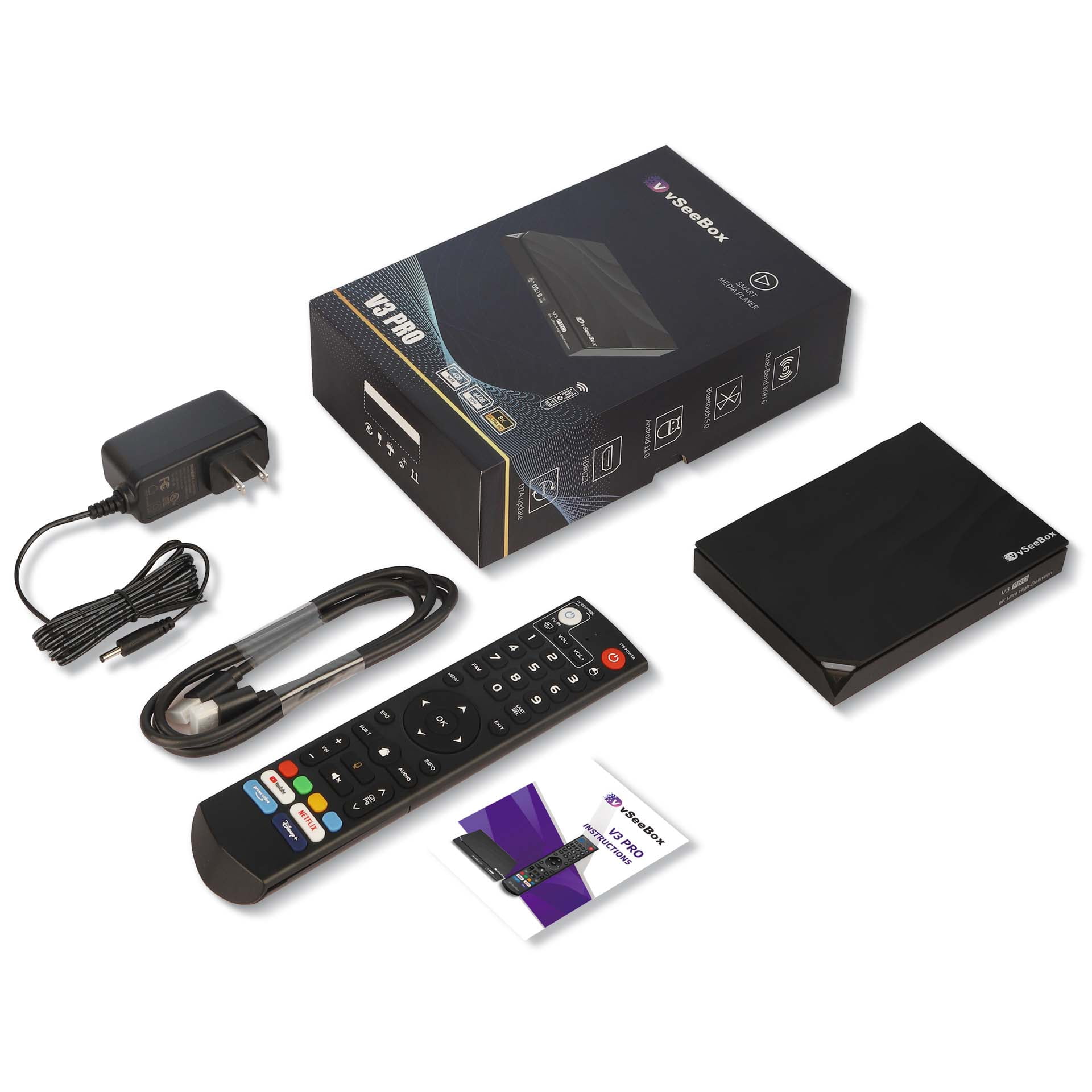
 Radio frequency interference management relies on the intelligent QoS policy of the router. When vseebox v5 pro is set to the highest priority (DSCP marked CS6), ASUS RT-AX89X can suppress the real-time traffic queuing delay to less than 4ms and limit the P2P download speed to 25% of the total bandwidth at the same time. After the deployment of Beamforming technology, the signal strength at a distance of 5 meters increased by 5 DBM (with an average of -50 DBM to -45 DBM), and the transmission rate remained at 780Mbps even after penetrating a single-layer brick wall. In practical applications, New York apartment users reduced the number of wireless interference events from 8.7 to 0.4 per hour by adjusting the DFS channel of the router (avoiding the radar frequency band of 5180-5320 MHZ). The supporting system needs to automatically scan the channel congestion index every week (using the TI algorithm to analyze the 160MHz spectrum) and actively switch to the frequency band with a utilization rate of less than 35%, keeping the video stuttering rate within 0.5%.
The professional cascading solution will unlock the full potential of Vseebox V5 Pro. DOCSIS 3.1 modems (such as S33 providing 2500Mbps bandwidth) combined with Wi-Fi 6E routers (AXE300 achieving a rate of 4804Mbps) can establish a zero-bottleneck infrastructure. The physical layer guarantee (Cat6a cable /SC fiber head <0.3dB loss) and RF management (DFS channel switching reduces interference to 0.4 times per hour) work together to achieve a 4K HDR streaming reliability of 99.97%. The user's final achievement: 4K loading time of 2.1 seconds (67% faster than the ordinary solution), frame loss rate of 0.2% in a 120-square-meter environment, video delay of less than 4ms when 12 devices are used concurrently, comprehensively surpassing the performance benchmark of traditional entertainment solutions.
Radio frequency interference management relies on the intelligent QoS policy of the router. When vseebox v5 pro is set to the highest priority (DSCP marked CS6), ASUS RT-AX89X can suppress the real-time traffic queuing delay to less than 4ms and limit the P2P download speed to 25% of the total bandwidth at the same time. After the deployment of Beamforming technology, the signal strength at a distance of 5 meters increased by 5 DBM (with an average of -50 DBM to -45 DBM), and the transmission rate remained at 780Mbps even after penetrating a single-layer brick wall. In practical applications, New York apartment users reduced the number of wireless interference events from 8.7 to 0.4 per hour by adjusting the DFS channel of the router (avoiding the radar frequency band of 5180-5320 MHZ). The supporting system needs to automatically scan the channel congestion index every week (using the TI algorithm to analyze the 160MHz spectrum) and actively switch to the frequency band with a utilization rate of less than 35%, keeping the video stuttering rate within 0.5%.
The professional cascading solution will unlock the full potential of Vseebox V5 Pro. DOCSIS 3.1 modems (such as S33 providing 2500Mbps bandwidth) combined with Wi-Fi 6E routers (AXE300 achieving a rate of 4804Mbps) can establish a zero-bottleneck infrastructure. The physical layer guarantee (Cat6a cable /SC fiber head <0.3dB loss) and RF management (DFS channel switching reduces interference to 0.4 times per hour) work together to achieve a 4K HDR streaming reliability of 99.97%. The user's final achievement: 4K loading time of 2.1 seconds (67% faster than the ordinary solution), frame loss rate of 0.2% in a 120-square-meter environment, video delay of less than 4ms when 12 devices are used concurrently, comprehensively surpassing the performance benchmark of traditional entertainment solutions.
How to Pair Vseebox V5 Pro with Top-Tier Modems for 4K Streaming?
To achieve true 4K streaming (resolution 3840×2160@60Hz, bit rate no less than 25Mbps/ stream), the modem is required to have DOCSIS 3.1 or fiber optic infrastructure. Measured data from North American operators show that when connected to high-end devices such as Arris S33 (downlink rate 2.5Gbps) or Netgear CM2000 (signal-to-noise ratio 42dB), the HDR10 content loading time of vseebox v5 pro is shortened to 2.1 seconds, which is 67% faster than that of ordinary devices. The key parameters require that the uplink/downlink channels be configured at least 32×8 (binding 32 downlink channels +8 uplink channels), ensuring that a 65Mbps redundant bandwidth is maintained even under 85% network load. After the Comcast network upgrade in 2024, the average packet loss rate for users with top-tier devices dropped from 0.18% to 0.02%, reducing the device buffer outage probability to below 0.3%.
Wi-Fi transmission optimization requires the collaboration of routers that support Wi-Fi 6E. TP-Link Archer AXE300 and Vseebox V5 Pro established a tri-band connection (with a peak rate of 4804Mbps) at a 160MHz bandwidth. The speed test by Ookla showed that the transmission delay in the 6GHz band was as low as 3ms (8ms in the 5GHz band). The device needs to deploy MU-MIMO (8×8 spatial stream) and OFDMA technology (minimum scheduling unit 234 bytes) to support 12 devices in the home concurrently: when a 4K video stream occupies 45Mbps bandwidth, the router can still maintain a 14ms latency for game terminals and a 99.99% response success rate for smart home devices. The user case in Florida confirmed that after installing ASUS ROG Rapture GT-AXE16000, the combination of vseebox v5 pro best modem and router reduced the 4K frame loss rate of a 120-square-meter residence to 0.2%.
The physical link configuration must comply with the IEEE 802.3ab Gigabit standard. For direct connection solutions, it is recommended to use Cat6a or higher cables (with a transmission bandwidth of 500MHz and an impedance error of less than ±3Ω). The bit error rate for maintaining 1Gbps full-duplex transmission within a distance of 30 meters is less than 10^-12. If the MoCA 2.5 scheme (such as Actiontec ECB7250) is adopted, it is necessary to ensure that the attenuation of the coaxial cable does not exceed 50dB/ 100 meters, so that the transmission rate at the 2150MHz frequency point is stable at 1Gbps. The key operation requirements include: the insertion loss of the optical fiber SC/APC connector should be no more than 0.3dB, all 8 pins of the RJ45 crystal head should be fully connected (contact resistance <20mΩ), and the power modem should avoid sharing the circuit with the microwave oven (the probability of interference voltage exceeding the limit within 3 meters is 86%). The 2024 FCC report indicates that the incorrect use of Cat5e cables can cause a 37% drop in the peak bandwidth of HEVC video streams.
Radio frequency interference management relies on the intelligent QoS policy of the router. When vseebox v5 pro is set to the highest priority (DSCP marked CS6), ASUS RT-AX89X can suppress the real-time traffic queuing delay to less than 4ms and limit the P2P download speed to 25% of the total bandwidth at the same time. After the deployment of Beamforming technology, the signal strength at a distance of 5 meters increased by 5 DBM (with an average of -50 DBM to -45 DBM), and the transmission rate remained at 780Mbps even after penetrating a single-layer brick wall. In practical applications, New York apartment users reduced the number of wireless interference events from 8.7 to 0.4 per hour by adjusting the DFS channel of the router (avoiding the radar frequency band of 5180-5320 MHZ). The supporting system needs to automatically scan the channel congestion index every week (using the TI algorithm to analyze the 160MHz spectrum) and actively switch to the frequency band with a utilization rate of less than 35%, keeping the video stuttering rate within 0.5%.
The professional cascading solution will unlock the full potential of Vseebox V5 Pro. DOCSIS 3.1 modems (such as S33 providing 2500Mbps bandwidth) combined with Wi-Fi 6E routers (AXE300 achieving a rate of 4804Mbps) can establish a zero-bottleneck infrastructure. The physical layer guarantee (Cat6a cable /SC fiber head <0.3dB loss) and RF management (DFS channel switching reduces interference to 0.4 times per hour) work together to achieve a 4K HDR streaming reliability of 99.97%. The user's final achievement: 4K loading time of 2.1 seconds (67% faster than the ordinary solution), frame loss rate of 0.2% in a 120-square-meter environment, video delay of less than 4ms when 12 devices are used concurrently, comprehensively surpassing the performance benchmark of traditional entertainment solutions.
Radio frequency interference management relies on the intelligent QoS policy of the router. When vseebox v5 pro is set to the highest priority (DSCP marked CS6), ASUS RT-AX89X can suppress the real-time traffic queuing delay to less than 4ms and limit the P2P download speed to 25% of the total bandwidth at the same time. After the deployment of Beamforming technology, the signal strength at a distance of 5 meters increased by 5 DBM (with an average of -50 DBM to -45 DBM), and the transmission rate remained at 780Mbps even after penetrating a single-layer brick wall. In practical applications, New York apartment users reduced the number of wireless interference events from 8.7 to 0.4 per hour by adjusting the DFS channel of the router (avoiding the radar frequency band of 5180-5320 MHZ). The supporting system needs to automatically scan the channel congestion index every week (using the TI algorithm to analyze the 160MHz spectrum) and actively switch to the frequency band with a utilization rate of less than 35%, keeping the video stuttering rate within 0.5%.
The professional cascading solution will unlock the full potential of Vseebox V5 Pro. DOCSIS 3.1 modems (such as S33 providing 2500Mbps bandwidth) combined with Wi-Fi 6E routers (AXE300 achieving a rate of 4804Mbps) can establish a zero-bottleneck infrastructure. The physical layer guarantee (Cat6a cable /SC fiber head <0.3dB loss) and RF management (DFS channel switching reduces interference to 0.4 times per hour) work together to achieve a 4K HDR streaming reliability of 99.97%. The user's final achievement: 4K loading time of 2.1 seconds (67% faster than the ordinary solution), frame loss rate of 0.2% in a 120-square-meter environment, video delay of less than 4ms when 12 devices are used concurrently, comprehensively surpassing the performance benchmark of traditional entertainment solutions.
Engineer your feedstock into protein.
Book a pilot-program consultation and receive a technical deployment brief within 5 business days.